Affiliate Disclosure: This post contains affiliate links. If you purchase through them, I may earn a small commission at no extra cost to you. Thank you for supporting Fun Joy Studio!
Every year it goes the same way. You decide you’re going to host. You picture candles and mulled wine and everyone laughing around the table. Then December arrives, the guest list grows, the to-do list multiplies, and suddenly it’s the day of the party and you’re vacuuming in your good sweater while guests are already ringing the doorbell.
This is the part nobody warns you about when you say yes to hosting Christmas. The party itself is wonderful. The getting-there is the part that needs a plan.
This guide is about how to plan a Christmas party so you actually enjoy it, not just survive it. From the first guest list to the last clean dish, here’s how to break it down so nothing piles up at the end.
Start With the Only Question That Actually Matters
Before you pick a date, write a menu, or buy a single decoration, answer this: what kind of party do you actually want to host?
Not the party you feel like you should host. Not the Instagram-perfect dinner party with twelve coordinated place settings. The party that fits your home, your budget, your guest list, and the amount of energy you genuinely have in December.
Because the single biggest source of Christmas party stress isn’t the work involved. It’s the gap between the party you imagined and the party you’re actually equipped to throw. Close that gap first and everything that follows gets easier.
A few questions worth answering before you plan anything else:
- How many people? Under 15 is an intimate gathering. 15 to 30 is a proper party. Over 30 is an event that needs a different level of logistics. The number shapes every other decision.
- Sit-down dinner or casual? A seated dinner requires a full menu, enough chairs, and table settings. A casual party with a buffet or grazing table is significantly easier to execute and often more fun. Neither is wrong, but picking one early prevents you from planning for both and doing neither well.
- Adults only or family? Kids at a Christmas party change the entertainment needs, the menu considerations, and the noise level. Plan for the actual guest list, not a theoretical one.
Once you have answers to these three questions, you have a party concept. Everything else is logistics.

The Guest List and Invitations
Send invitations earlier than you think you need to. December is the busiest social month of the year: people have multiple commitments, family obligations, and other parties competing for every weekend. Getting on calendars in October or early November is not too early. It’s strategic.
A few practical notes:
Invite more people than you want to attend. December RSVPs are notoriously unreliable: expect roughly 20 to 30% of invitees to decline or not show. Over-inviting slightly protects you from a smaller gathering than you planned for.
Collect RSVPs with a firm date: not “let me know when you can” but “please respond by [date].” Vague RSVP requests produce vague responses and you can’t plan a menu without a headcount.
Keep a running guest list that includes name, contact information, RSVP status, and whether they’re bringing children. A simple list on paper or in your planner prevents the last-minute confusion of not knowing who confirmed and who you’re still waiting on.
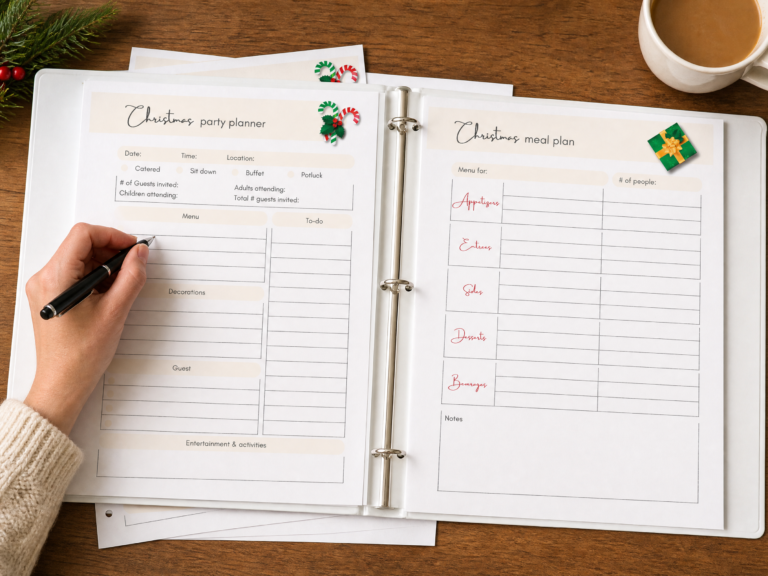
If you’re using a Christmas Planner, the party guest list page handles exactly this: name, address, phone number, all in one place so you’re not hunting through texts when the caterer asks for a final count.
Setting Your Christmas Party Budget
The number one reason Christmas hosting feels overwhelming is that the costs are invisible until they’re all due at once. Budget before you buy anything.
What most hosts forget to budget for:
The obvious items are food and drinks. The ones that sneak up: serving platters and decorations you don’t already own, extra chairs or a folding table, disposable plates and cups if you’re not doing formal table settings, candles and flowers, party favors if you’re doing them, and the extra cleaning supplies you’ll need before and after.
How to build your Christmas party budget:
Start with a total number: the maximum you’re comfortable spending on this event regardless of how the line items break down. Then allocate backwards: roughly half to food and drinks, a quarter to décor and supplies, and the remainder as a buffer for things you didn’t anticipate.
Track actual versus estimated spending as you go rather than adding it up at the end. The gap between what you think you spent and what you actually spent is usually where the January regret comes from.
A Christmas budget planner with separate line items for each category (food, décor, entertainment, supplies) gives you a complete picture rather than a vague sense that you’re “within budget.” The Christmas Planner from Print Joy Studio includes dedicated budget pages for each category so nothing gets missed.
The Menu: Plan for What You Can Actually Execute
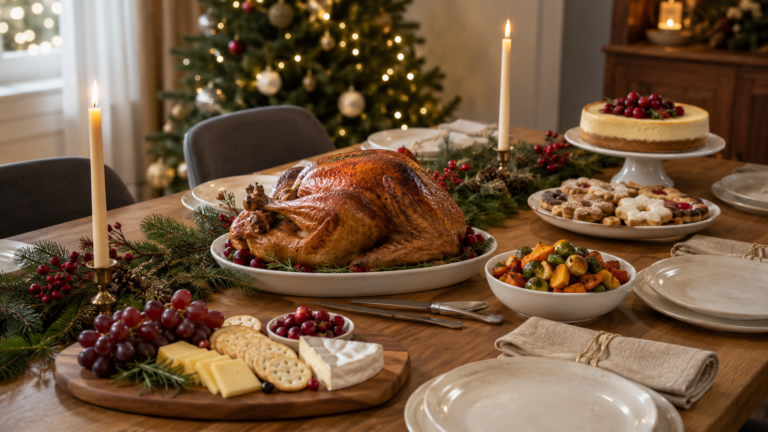
The best Christmas party menu is not the most impressive one. It’s the one you can execute without being trapped in the kitchen from 2pm to 8pm.
The prep-ahead principle: Every item on your Christmas party menu should be evaluated for how far in advance it can be made. Soups, casseroles, marinated proteins, most desserts, and all dips can be made one to two days ahead. Items that require active cooking the day of the party should be limited to one or two at most, and they should be things that can sit and wait while you talk to your guests.
Menu structure for a Christmas party:
- One or two appetizers guests can graze on as they arrive. This covers the arrival window while you’re finishing last-minute prep, and it means nobody is standing around hungry waiting for food to be ready.
- A main dish or two that were largely prepared the day before and just need reheating or finishing.
- Two to three sides, at least one of which is served cold and requires no day-of preparation at all.
- One or two desserts. Christmas cookies made ahead of time, a cheesecake made the night before, or a simple trifle that assembles in ten minutes. Dessert does not need to be homemade.
- Drinks set up as a self-serve station: hot apple cider in a slow cooker, a hot cocoa bar, wine and beer on a table. A self-serve drink station removes one of the most time-consuming hosting jobs and guests genuinely enjoy making their own drinks.
The grocery list strategy: Write your complete grocery list organized by store section (produce, dairy, meat, pantry, frozen) and note which items can be bought a week ahead versus what needs to be fresh. Shopping in two separate trips (the bulk of it a week before, the perishables two days before) is significantly less stressful than one enormous shop the day before the party.
Decorations: Beautiful Doesn’t Have to Mean Elaborate
Christmas decorations create atmosphere, and atmosphere is what guests remember. But elaborate doesn’t mean memorable. Intentional does.
The three elements that do the most work:
- Lighting does more for Christmas party atmosphere than any other single element. Dimmed overhead lights, candles on every surface, and string lights in unexpected places (draped over a bookshelf, wrapped around a banister, in a glass vase) create the warm glow that makes a party feel like Christmas rather than a well-lit dinner.
- Scent is the most underrated party planning tool available. Hot apple cider in a slow cooker makes your entire house smell like Christmas from the moment guests walk in. Cinnamon sticks and orange slices in a bowl on a side table, fresh greenery from the grocery store. These are inexpensive and create an immediate sensory impression that guests don’t forget.
- One or two focal points rather than decorations everywhere. A beautifully set table, a mantle with candles and greenery, a decorated doorway: choose one or two spots to decorate intentionally and leave the rest of the space clean. Overdecoration creates visual noise. A few well-placed moments create magic.
Inventory before you shop. Before buying a single decoration, pull out everything you already own and see what you have. Most hosts buy duplicates every year because they forgot what they had. A simple décor inventory list (what you own, where it’s stored) prevents this and saves real money over time.
Entertainment: The Part Most Hosts Skip Until Too Late
Food and decorations get planned first. Entertainment gets remembered the week of the party and then scrambled together. This is backwards.
Entertainment is what your guests actually remember. The food was good. The decorations were lovely. But the game where everyone was in tears laughing? That’s what gets mentioned every year when someone brings up that Christmas party.
A Christmas party entertainment plan doesn’t need to be complicated. For a casual gathering of 10 to 20 people, one main activity (a game, a group challenge, a gift exchange) plus a good playlist is more than enough. For larger parties, a passive activity that runs itself (a Christmas trivia question board, a “guess the year this photo was taken” display using old family photos) works alongside the main event.
Game ideas that work for any Christmas party: A Christmas Feud-style survey game is the strongest main event for any adult group: competitive, funny, and completely level regardless of Christmas knowledge. Teams compete to match popular survey answers to Christmas-themed questions. The Fast Money Round finale is reliably the loudest moment of the evening.
A gift exchange game like Pass the Prize or Left Right turns what would otherwise be a standard swap into something everyone participates in simultaneously. The poem or story format creates genuine suspense in a way that a simple name draw never does.
Christmas Jeoparty brings the full game-show experience for groups who want a proper competition: two complete game boards, five categories with 25 questions each, and a Final Jeoparty round where the whole thing can flip. It plays best as its own event rather than a quick filler, so save it for a group that’s ready to sit down, form teams, and go a few rounds.
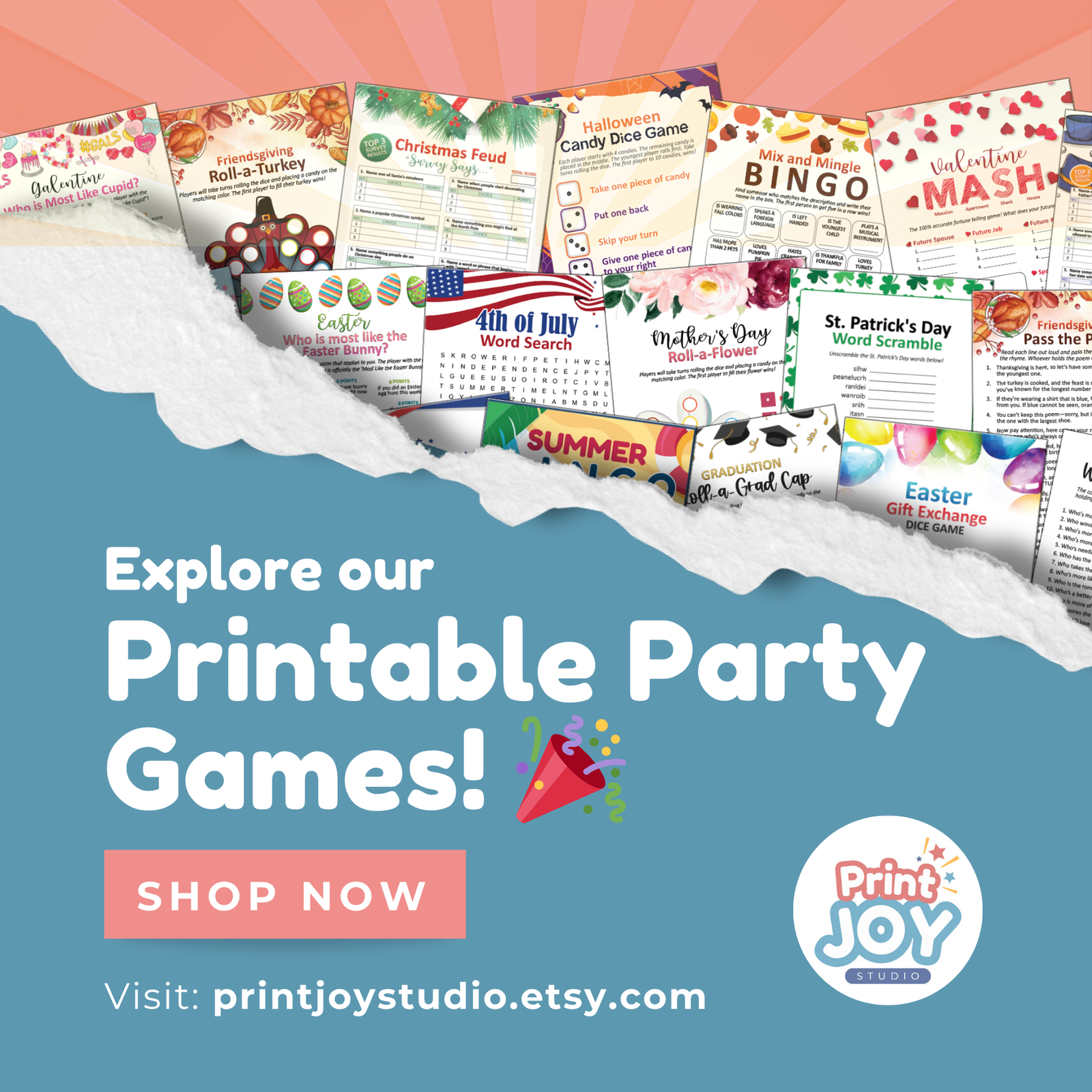
If entertainment is the part you’re most likely to leave until the last minute, our Ultimate Guide to Printable Christmas Games has the full breakdown: every game sorted by group size, energy level, and how much setup it needs.
Browse all printable Christmas party games at printjoystudio.etsy.com.
The Timeline: When to Do What
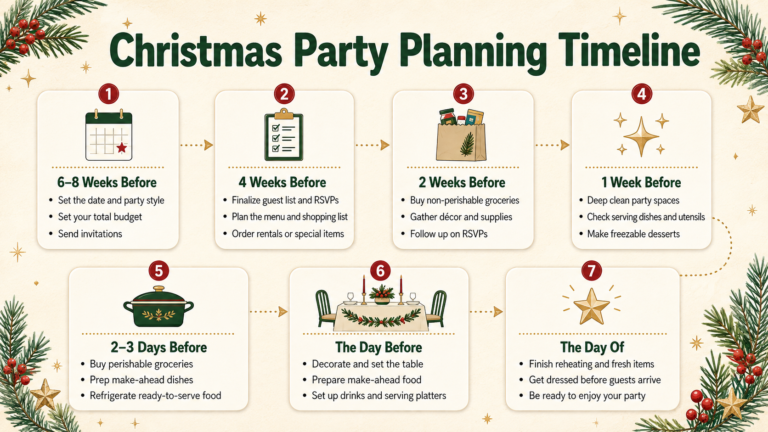
This is the section that actually prevents the day-of scramble. A realistic Christmas party planning checklist organized by when to do things is worth more than any tip about what to do.
- 6 to 8 weeks before: Set your date. Decide on format (casual, seated dinner, buffet). Set your total budget. Send invitations.
- 4 weeks before: Finalize guest list and collect RSVPs. Plan your menu. Make your shopping list. Order anything that needs to be shipped or reserved (specialty food items, rental equipment, anything being personalized).
- 2 weeks before: Buy all non-perishable groceries and pantry items. Buy or gather all décor and supplies. Confirm RSVPs with anyone who hasn’t responded.
- 1 week before: Deep clean the main party spaces. Pull out serving dishes, platters, and utensils and make sure you have everything you need. Make any desserts that can be frozen.
- 2 to 3 days before: Buy perishable groceries. Prep any dishes that can be made ahead: casseroles, dips, marinated proteins, desserts that keep in the fridge.
- The day before: Decorate. Set the table. Prepare all food that can be made ahead and refrigerate. Set up the drink station. Lay out serving platters and label which dish goes on which platter so you’re not deciding this with guests arriving.
- The day of: Only finish the things that genuinely need to be done on the day: final reheating, fresh items that can’t be prepped ahead. Get dressed before guests arrive. Be in the room when the first person walks through the door.
This last point sounds obvious. It isn’t. The host who is still in the kitchen when the first guest arrives never quite catches up to the party. Getting yourself done before anything else on party day is a mindset shift that changes the entire hosting experience.
The Secret to Actually Enjoying Your Own Party
Everything above is logistics. This part is about you.
The hosts who enjoy their own Christmas parties are the ones who made a decision in advance to be present rather than perfect. The appetizer that didn’t turn out quite right gets replaced with something from the grocery store. The decoration that fell down stays down. The game that ran ten minutes longer than planned runs ten minutes longer.
Nobody came to your party to evaluate your execution. They came because you invited them and they wanted to be there. Your presence (laughing, talking, participating in the game, sitting down to eat with everyone) is more important than any single thing on your to-do list.
Plan as thoroughly as you can. Then let the plan do its job while you enjoy the evening you created.
The Christmas Planner: Everything in One Place
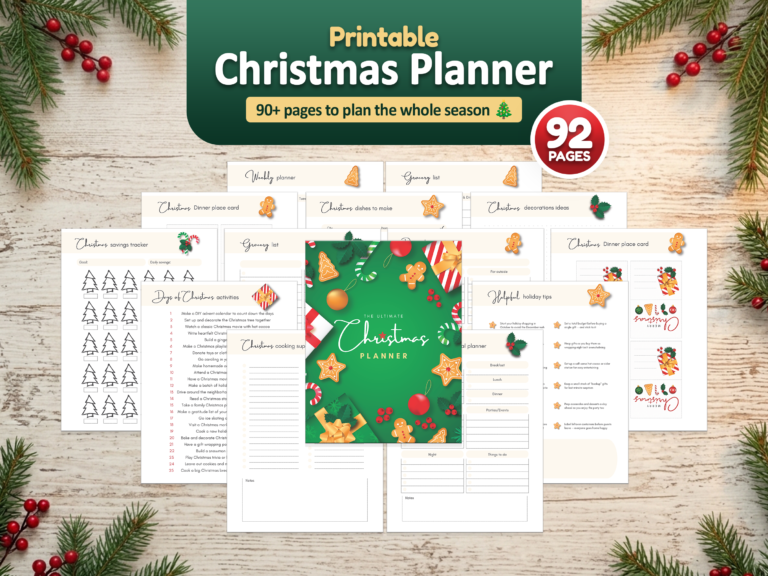
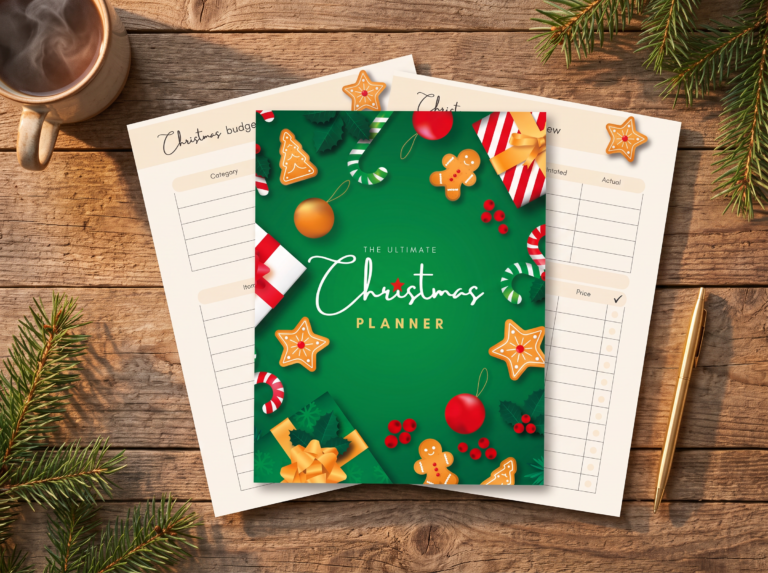
If you’re hosting this year and want a single resource that holds all of it together, the Christmas Planner from Print Joy Studio is a 92-page printable planner that covers every aspect of Christmas planning in one beautifully designed download.
Gift planning pages for every category: family, friends, co-workers, teachers, neighbors, charity, spouse, and children. Each with columns for the gift, store, price, and whether it’s been sent.
Budget pages for every spending category (gifts, food, décor, parties, photos) plus Christmas savings trackers so you can see your progress.
Meal planning pages for Christmas Eve and Christmas Day, a complete cooking schedule, grocery lists organized by store section, and recipe pages.
A party planner with guest list, menu planning, decoration checklist, and entertainment planning all in one section.
Activity planning: the 25 Days of Christmas activities, a Christmas bucket list, family traditions tracker, Christmas books and movies lists, and a Christmas memories page.
Organization pages: master to-do lists broken down by October, November, and December, a 7-day cleaning schedule, a decorating planner, décor inventory lists, and a wrapping checklist.
It’s the Christmas planning system that keeps everything in one place so nothing gets forgotten and nothing piles up at the end.
Download the Christmas Planner here. Instant download, print the pages you need, use it the way that works for you.
Christmas Party Planning Checklist
A quick reference checklist: print this or save it for easy access as you plan.
- 6 to 8 weeks out: Set the date, format, and budget. Send invitations.
- 4 weeks out: Finalize RSVPs. Plan the menu and grocery list. Order anything that needs lead time.
- 2 weeks out: Buy non-perishable groceries. Gather décor and supplies. Follow up on outstanding RSVPs.
- 1 week out: Deep clean party spaces. Pull out serving dishes. Make freezable desserts.
- 2 to 3 days out: Buy perishables. Make all prep-ahead food.
- Day before: Decorate and set the table. Label serving platters. Set up the drink station.
- Day of: Finish only what has to be done today. Get dressed first. Be ready when guests arrive.
Frequently Asked Questions
How far in advance should you plan a Christmas party?
Start 6 to 8 weeks ahead, earlier than most people think. December calendars fill quickly and the earlier you send invitations, the better your RSVPs will be. Most of the practical planning (menu, shopping, decorating) happens in the two weeks before the party.
How do you plan a Christmas party on a budget?
Set a total budget before buying anything. Allocate roughly half to food and drinks, a quarter to décor and supplies, and keep a buffer for unexpected costs. Prep-ahead cooking reduces food waste. A self-serve drink station is significantly cheaper than buying and serving individual drinks throughout the evening. Decorating with what you already own, supplemented by a few intentional new pieces, costs far less than starting fresh every year.
What do you need for a Christmas party checklist?
A complete Christmas party planning checklist covers: guest list and RSVPs, total budget and per-category spending limits, full menu with prep-ahead schedule, grocery list organized by section, decoration plan by room, entertainment activity, and a day-by-day timeline from six weeks out to the day of.
How many people should you invite to a Christmas party?
Invite 20 to 30% more people than you want to attend. December RSVPs are unreliable and you’re more likely to end up with a smaller group than you planned than a larger one. For a comfortable hosted dinner, plan for 8 to 12. For a casual party, 15 to 30 is manageable for most home spaces.
How do you host a Christmas party without stressing?
The answer is almost entirely in the timing. Hosts who are stressed on the day of the party front-loaded too much for that day. Prep-ahead cooking, advance decorating, setting up the drink station the night before, and getting dressed before any final tasks: these habits collectively shift the experience from scramble to enjoyment.
What are good Christmas party games for adults?
A Christmas Feud survey game works for any size adult group and is consistently the highest-energy activity of the evening. Gift exchange games like Pass the Prize or the Left Right Game turn a standard swap into shared entertainment. Christmas Jeoparty is the pick when you want trivia with real stakes: team boards, categories, and a Final Jeoparty round to settle it. All are available as printable instant downloads at printjoystudio.etsy.com.