Affiliate Disclosure: This post contains affiliate links. If you purchase through them, I may earn a small commission at no extra cost to you. Thank you for supporting Fun Joy Studio!
A scavenger hunt is one of those activities that gives you back more than you put in. Setup takes 15 to 20 minutes. The hunt keeps kids independently occupied for 20 to 40 minutes with zero adult involvement required once the clues are hidden. And the experience of following a trail of clues through the house to a prize at the end is the kind of thing kids actually remember, not just at this Halloween party, but at next Halloween when they ask to do it again.
The question isn’t whether to run a scavenger hunt. It’s which one fits the kids you have.
Picture Hunt, Rhyming Clues, or Puzzle Clues: Which One Is Right?
Three very different experiences. The two clue hunts share the same basic structure: clues hidden around the house, each pointing to the next, prize at the end. The picture hunt skips the clues entirely. But the player experience diverges significantly based on age and what kind of challenge feels satisfying versus frustrating.
- A picture hunt is the right choice when: your players are aged 3 to 8, they can’t read yet, you want no clues to follow at all, and you want the whole group searching at the same time.
- Rhyming clues are the right choice when: your players are aged 4 to 10, you want something that works even for kids who can’t read well yet, you want the activity to feel like a storybook adventure rather than a test, and you want the whole group to move together rather than splitting up.
- Puzzle clues are the right choice when: your players are aged 8 and up, they would find the rhyming version too easy and would say so out loud, you want the solving to be as satisfying as the finding, and you’re okay with the hunt taking longer because the challenge is the point.
For parties with a wide age range (older kids and younger siblings), run both simultaneously. Younger kids do the rhyming hunt while older kids tackle the puzzles. Both groups are occupied, both find appropriate challenge, and both end at a prize.
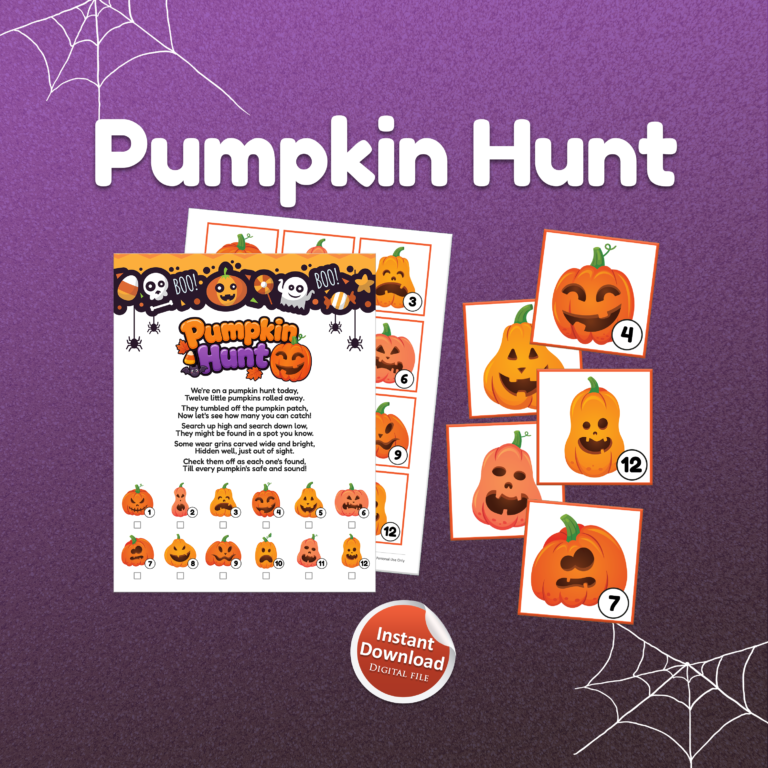
Halloween Pumpkin Hunt
The Halloween Pumpkin Hunt is the picture version, and it’s the one to grab for little ones. Twelve jack-o’-lanterns hide around the house, each with its own face. Some are silly, some are spooky, and one looks very surprised to be found.
There are no clues to read and no order to follow. Kids carry their tracker sheet, spot a pumpkin, and check it off. A 3-year-old can’t solve a riddle, but they can absolutely find the winking pumpkin tucked behind the couch cushion.
The hide cards come in two sizes:
- Small cards (12 per page) for sneaky spots
- Big cards (6 per page, two sets) so the littlest hunters can find them faster
- Best for: Ages 3 to 8. Any group size; just print a tracker sheet for each kid.
- Setup time: 5 to 10 minutes.
- Playing time: 15 to 30 minutes.
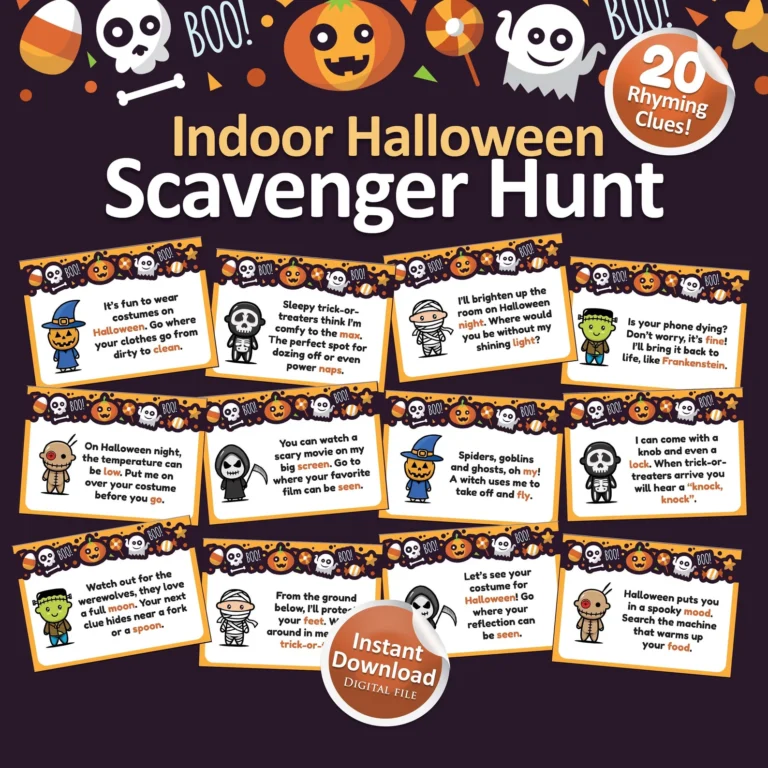
Halloween Indoor Scavenger Hunt
The Halloween Indoor Scavenger Hunt is the rhyming clue version: 20 clues hidden across 20 indoor locations, each one pointing to the next with a rhyme that gives away the location if you listen carefully enough.
The rhyming format has a warmth to it that the puzzle version doesn’t. Even kids who can’t read yet can participate when an adult or older sibling reads each clue aloud, and the delight of solving a rhyme and running to check the answer is specifically a young-kid delight.
The 20 hiding locations: Washing Machine, Bed, Lamp, Phone Charger, Jacket, TV, Clothes Dryer, Broom, Umbrella, Front Door, Shoes, Bathroom Mirror, Oven, Chair, Bathroom Sink, Utensil Drawer, Computer, Microwave, Freezer, Window.
Every location is listed in the instruction sheet, so setup requires zero creative thinking, just printing, cutting, and hiding. The starting message and ending message are included to frame the adventure properly. Print on cardstock for clues that hold up through excited kid hands.
- Best for: Ages 4 to 10. Groups of 2 to 6. Home Halloween parties, Halloween birthday parties.
- Setup time: 15 to 20 minutes.
- Playing time: 20 to 40 minutes.
Halloween Puzzle Scavenger Hunt
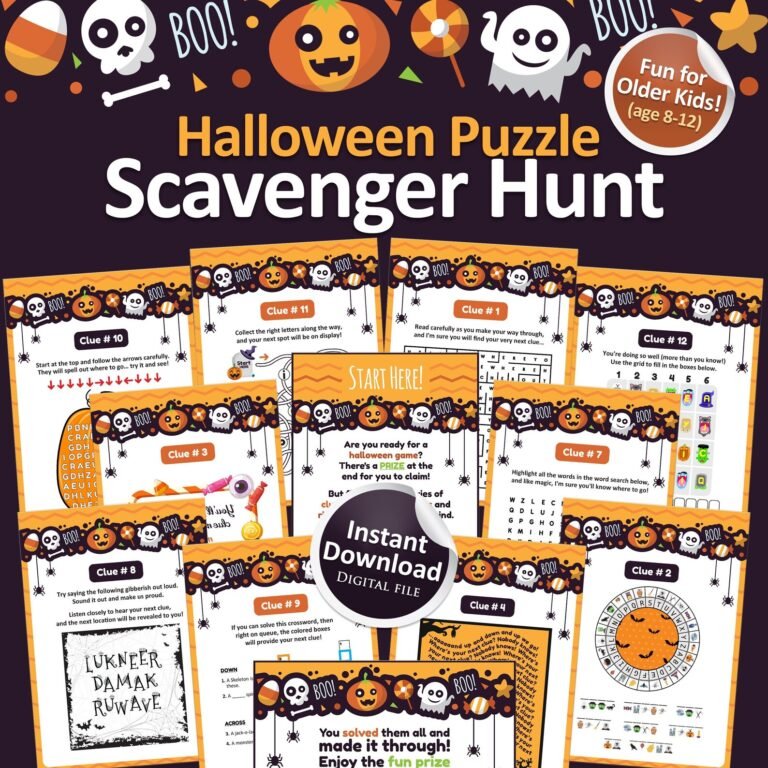
The Halloween Puzzle Scavenger Hunt replaces rhyming clues with actual puzzles: 12 puzzle-based clues for 12 indoor locations, where players solve a real challenge at each stage before the next location is revealed.
For kids who would roll their eyes at rhyming clues, this version delivers genuine problem-solving satisfaction. The 18-page PDF includes a how-to-solve guide for each puzzle type, which is useful for adults setting it up who want to understand what players will face.
On difficulty: The puzzles are genuinely challenging. That’s the point. If you’re unsure whether your group is ready, err on the side of pairing kids up rather than having each child work alone. Two kids together on a puzzle will usually get it when one alone might get stuck and frustrated.
- Best for: Ages 8 and up. Works for older kids, teens, and curious adults. Groups of 2 to 8 running in pairs or small teams.
- Setup time: 20 to 25 minutes.
- Playing time: 25 to 45 minutes.
How to Set Up Each Version
The setup process is the same for both clue hunts, just with different clues and locations.
- Print and cut. Cut the clue sheets into individual clue cards. Cardstock holds up better than regular paper through excited kid hands.
- Read through all clues first. Before hiding anything, read the full sequence. The instruction sheet lists all hiding locations in order. This takes about five minutes and means you understand the route before you start.
- Hide in reverse order. Start with the last clue at the prize location and work backward to the first. This is the most common setup mistake: people hide clue 1 first and lose track of what goes where. Start at the end.
- Place the prize. The final hiding location gets the prize. A Halloween candy bag, a small gift, a Halloween craft kit. Something that feels earned.
- Give players the starting message. The starting message kicks off the adventure. The hunt runs itself from there.
For the Pumpkin Hunt, skip the reverse-order hiding completely. There’s no clue chain, so tuck the pumpkins anywhere, in any order. For preschoolers, keep them at eye level.
Hiding difficulty: For younger kids, hide clues in obvious parts of each location, like on top of the lamp, taped to the front of the TV. For older kids, hide more creatively, like rolled inside an umbrella, folded inside a jacket pocket. The hunt is more satisfying when the discovery requires a small search, not just a glance.
Prize Ideas
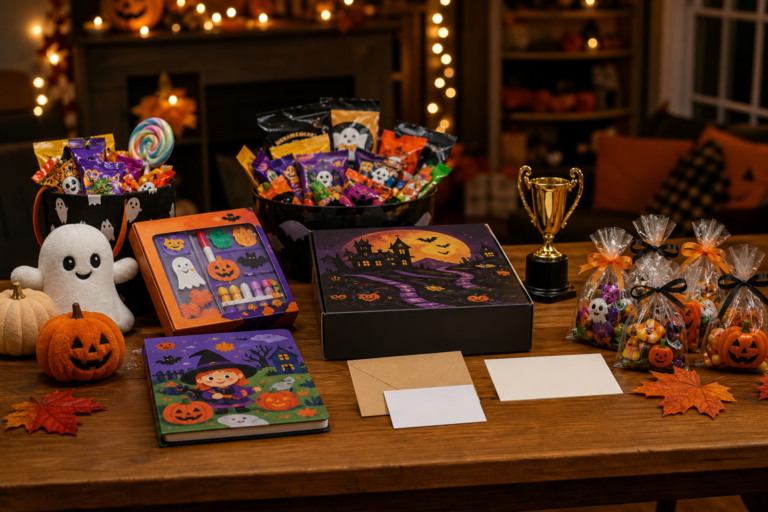
The prize matters more than it might seem. Kids who know a prize is waiting at the end are more motivated through the harder clues in the middle of the hunt.
- For young kids: A Halloween candy bag filled with favorites. A small Halloween toy. A Halloween craft kit. A Halloween book.
- For older kids: A larger candy haul. A Halloween-themed game to play after the hunt. A gift card. An experience voucher (movie choice, staying up late, choosing the next Halloween game).
- For groups: The first team to finish wins the prize, and everyone gets a small consolation candy for completing the hunt. No one leaves empty-handed.
What to Do After the Hunt
The scavenger hunt is most effective as part of a broader activity plan rather than the only activity of the evening. Here’s what pairs well with it:
- Before the hunt: Halloween Bingo as a seated group activity while everyone arrives. Once the group is ready, send them on the hunt.
- After the hunt: Roll-a-Pumpkin or the Halloween Candy Dice Game as a candy-based wind-down while the post-hunt energy settles.
- For older kids after the hunt: Halloween Feud or Halloween Charades as the competitive main event.
For a complete Halloween party game lineup covering every moment of the evening, head to The Best Halloween Party Games for Any Group.
Frequently Asked Questions
- What is a halloween scavenger hunt?
A halloween scavenger hunt is an activity where players follow a series of clues hidden around the house, each clue revealing the location of the next, until the final clue leads to a prize. Three printable versions are available: a picture hunt for ages 3 to 8, rhyming clues for ages 4 to 10, and puzzle clues for ages 8 and up. Looking for other Halloween game ideas to pair with the hunt? Browse the full guide at The Best Halloween Party Games for Any Group. - How do you set up a halloween scavenger hunt?
Print and cut the clues, read through the full sequence, hide clues in reverse order starting with the last clue at the prize location, place the prize, and give players the starting message. Setup takes 15 to 25 minutes for the clue hunts. The Pumpkin Hunt is even quicker: print, cut, and tuck the pumpkins anywhere in 5 to 10 minutes. - Which halloween scavenger hunt is right for my group?
The Pumpkin Hunt for ages 3 to 8 or kids who can’t read yet. Rhyming clues (Indoor Scavenger Hunt) for ages 4 to 10. Puzzle clues (Puzzle Scavenger Hunt) for ages 8 and up. For mixed ages, run the Pumpkin Hunt for the little ones while older kids work through the clues. - How long does a halloween scavenger hunt take?
The Pumpkin Hunt runs 15 to 30 minutes, with 5 to 10 minutes of setup. The Indoor Scavenger Hunt runs 20 to 40 minutes. The Puzzle Scavenger Hunt runs 25 to 45 minutes. Both run completely independently once clues are hidden. - Can more than one child play at the same time?
Yes! The Pumpkin Hunt works for any group size, since every kid gets their own tracker sheet and everyone searches at once. The two clue hunts work best for 2 to 8 players. For bigger groups, run those in pairs or small teams so everyone stays actively involved.
Shop all printable Halloween games at printjoystudio.etsy.com