Affiliate Disclosure: This post contains affiliate links. If you purchase through them, I may earn a small commission at no extra cost to you. Thank you for supporting Fun Joy Studio!
You’re going to be the emcee. Or someone handed you this guide because they want you to be the emcee. Either way, you’re in the right place.
But first. If you haven’t played Halloween Feud before, here’s why it’s worth your Halloween party.
Halloween Feud is a printable party game based on the Family Feud format, designed specifically for Halloween gatherings. Teams compete to match the most popular survey answers to Halloween-themed questions. The goal isn’t Halloween trivia knowledge. It’s predicting what most people said. That single mechanic makes it completely level for every age, every background, and every level of Halloween obsession in the room.
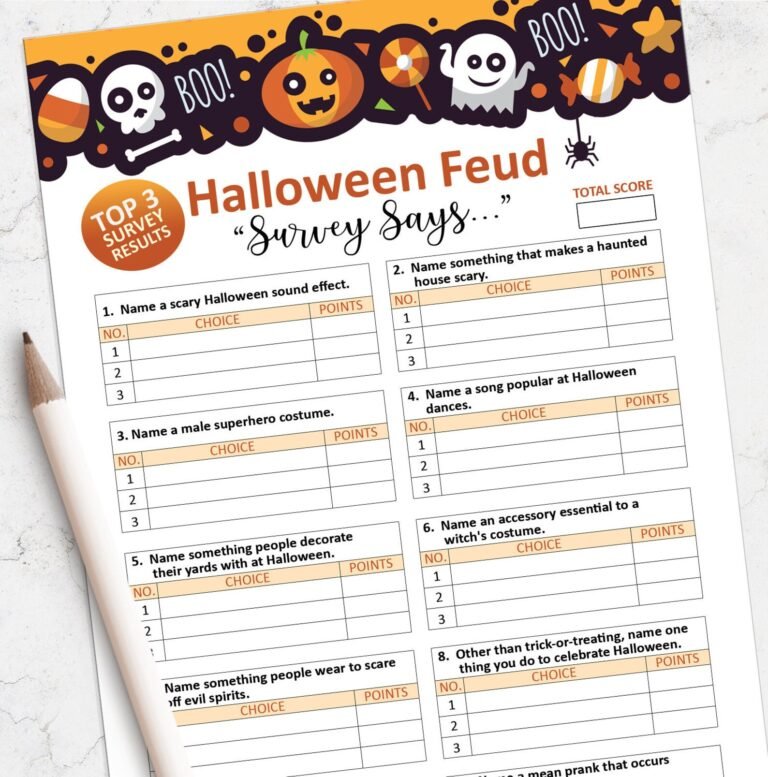
The game runs in two parts. Part 1 is the main Feud: ten Halloween questions, answers revealed one at a time, points awarded for matching the top survey results. Part 2 is the Fast Money Round, where the top two scorers face off head-to-head in front of the entire group. Three questions, higher stakes, and the kind of pressure that produces the moments everyone references for the rest of the evening.
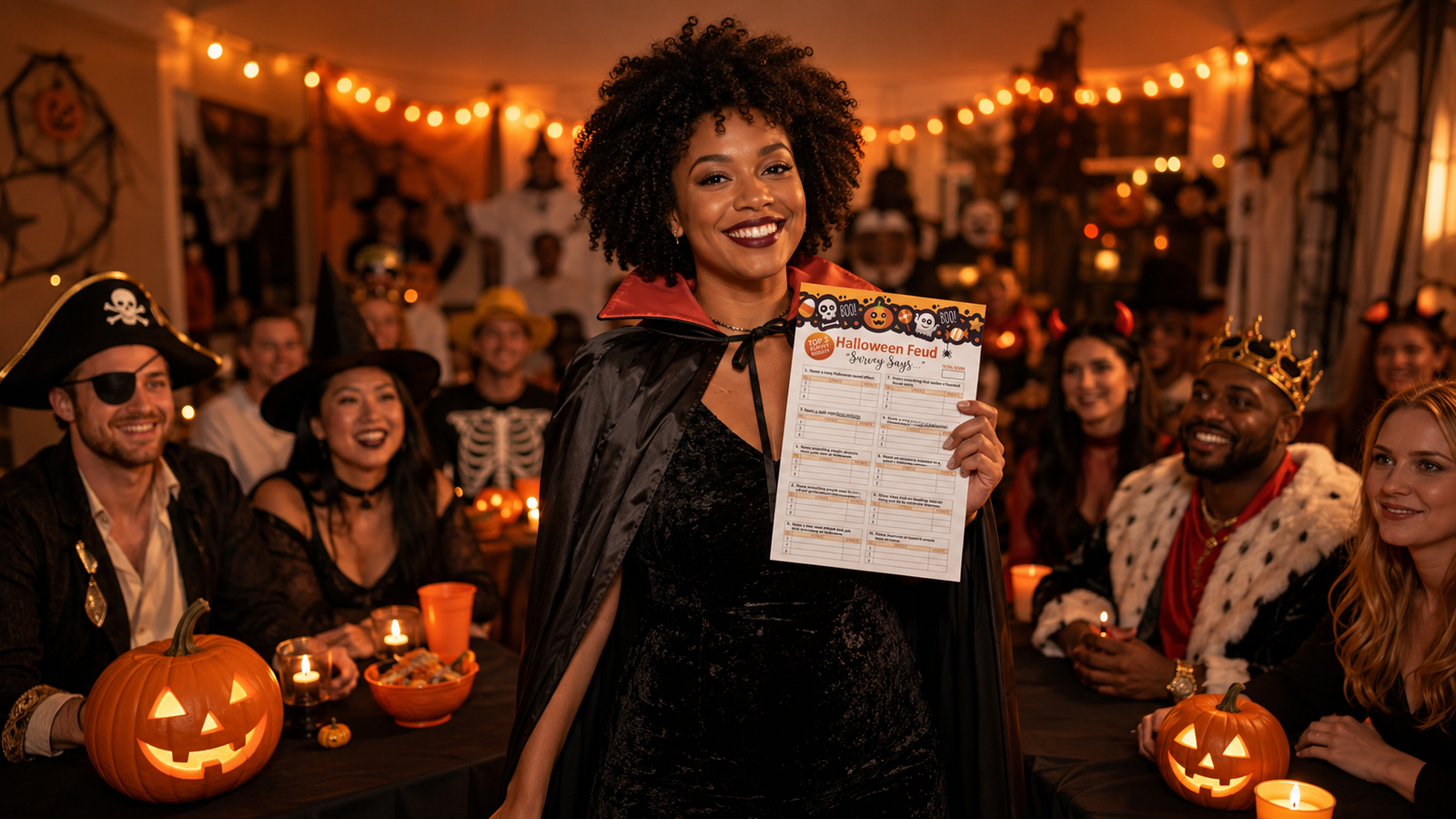
It works for groups of 8 or groups of 50. It works for school staff parties, neighborhood Halloween gatherings, family nights, and office events. Julie printed hers in color and made copies for all her guests. Malinda ran it for school staff and said everyone enjoyed it, especially the winner.
It’s an instant download. Print the morning of your party and have a complete game ready before the first guest arrives.
Now. The rules take five minutes. The emcee work is what makes the game genuinely memorable. Here’s how to do both.
What the Game Is (The Short Version)
Teams predict the most popular survey answers to Halloween-themed questions. Points for matching the top three survey answers. The Fast Money Round puts the top two scorers head-to-head in front of the whole room.
That’s the game. Now let’s talk about how to run it.
What’s in the Download
Halloween Feud includes 10 Feud questions (Part 1) for the main game, 3 Fast Money Round questions (Part 2) for the finale, a full instruction sheet, and an answer sheet with all survey answers and point values.
Available in 5×7, 8.5×11, and 8.5×11 with trim marks. Instant download. Print the morning of your party.
Setup
Print copies. One game sheet per player for individual play, one per team for team play. Print the Fast Money Round twice so both finalists have their own sheet.
Set up a scoreboard. A whiteboard, large notepad, or piece of paper taped to the wall all work. Visible scores make the competition feel real.
Decide on format. Under 12 guests: individual play. 12 or more: teams of three to five. For Halloween parties with mixed ages or mixed social groups, build teams deliberately. Putting different friend groups or generations on the same team produces the best dynamics.
Designate an emcee. More on this below.
The Rules
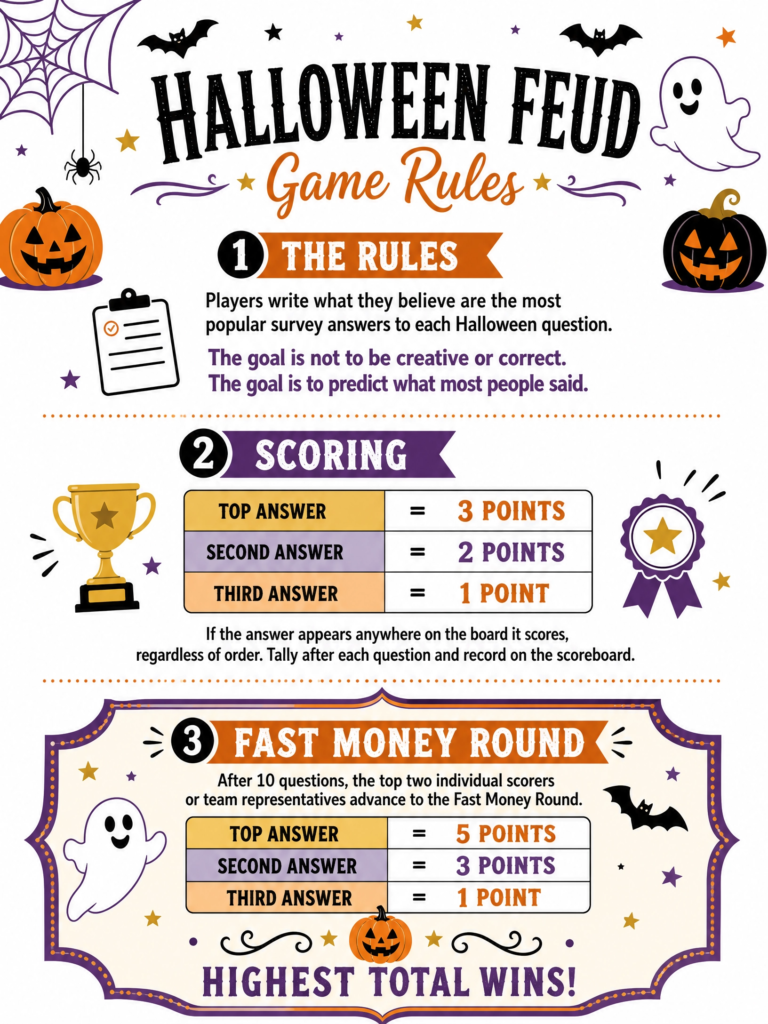
Players write what they believe are the most popular survey answers to each Halloween question. The goal is not to be creative or correct. The goal is to predict what most people said.
Scoring:
- Top answer: 3 points
- Second answer: 2 points
- Third answer: 1 point
If the answer appears anywhere on the board it scores, regardless of order. Tally after each question and record on the scoreboard.
After 10 questions, the top two individual scorers or team representatives advance to the Fast Money Round.
Fast Money Round scoring:
- Top answer: 5 points
- Second answer: 3 points
- Third answer: 1 point
Highest total wins.
Being the Emcee
This is the section that separates a good Halloween Feud from a great one.
The emcee has three jobs: read questions clearly, reveal answers dramatically, and keep the room’s energy high between rounds. The second job is the one that most first-time emcees get wrong.
The reveal is where the game lives. After reading a question and waiting for everyone to write their answers, open the answer sheet. Don’t read through it. Don’t skim to the end. Take one answer. Pause. Say it. Let the room react: groan, cheer, argue, compare. Then take the next answer. Same pause. Same permission for the room to respond.
The silence before each answer is not awkward. It’s the game. It’s the suspense. A reveal that takes ten seconds per answer creates more tension than a reveal that takes two. Trust the pause.
The “Survey says…” cadence matters. Say it before every reveal. People lean forward automatically when they hear it. It’s conditioned and it works every time.
Read the scoreboard aloud after each round. Not silently, not quickly. Tell the room what the score is and make it sound interesting. “Team Witch is sitting at 12, Team Vampire is right behind at 10. This is not over.” That one sentence keeps everyone invested even if their own score is out of contention.
Stir the pot during team huddles. When teams are discussing their answer, a casual “I’m hearing some disagreement on that side. Bold choice.” builds atmosphere without pressure.
The Fast Money Round
The Fast Money Round is the moment the whole game has been building toward. Give it that weight.
Announce it clearly. Separate the finalists so they cannot see each other’s answer sheets. Give each one a Fast Money Round sheet and a pen. Both answer all three questions simultaneously.
Then reveal the results one question at a time, with the longest pauses of the entire game. The first finalist’s answers first, then the second finalist’s. Add up the totals. Announce the winner last, not first.
A Fast Money Round that takes three minutes to reveal produces a different experience than one that takes thirty seconds. The room is completely invested at this point. They’ve been playing for 30 to 40 minutes. They know who these two people are. Give the finale the space it deserves.
Running It for Different Group Sizes
8 to 15 guests: Individual play. Everyone competes on their own. The Fast Money Round between the top two individual scores is genuinely exciting at this size.
15 to 30 guests: Teams of 3 to 5. The team debate before locking in an answer is part of the entertainment. Mix the groups deliberately.
30 or more: Teams of 6 to 8 work well. Or run two simultaneous games and bring the top scorers from each into a combined Fast Money Round finale. Keep everyone active rather than watching.

Prizes
The Fast Money Round winner deserves a prize worth winning. A Halloween candle, a nice chocolate box, a restaurant gift card: something that makes competing for it feel worthwhile.
Bonus idea: a small prize for the most confidently wrong answer of the evening. It rewards the behavior that makes the game most entertaining and gives the spectacular failures the recognition they deserve.
Frequently Asked Questions
How many people do you need for the Halloween Feud? As few as 4 playing individually and as many as 50 or more in teams. The sweet spot for an energetic game is 8 to 20.
How long does Halloween Feud take? 30 to 45 minutes including the Fast Money Round. For larger groups, allow 50 minutes.
Can kids play Halloween Feud? Yes. The survey format is completely level. It rewards intuition about popular opinion rather than specific knowledge. Kids aged 10 and up compete effectively alongside adults. Younger kids work well on a team with an adult.
Do I need an experienced emcee? No experience required. The instruction and answer sheets do the heavy lifting. The emcee just needs to slow down the reveals and let the room react to each answer.
Is Halloween Feud editable? The PDFs are not editable. Questions, answers, and point values are pre-set and ready to print. For personal use only.
Download Halloween Feud at printjoystudio.etsy.com
If you’re still building your full Halloween party lineup, the complete game guide is here: The Best Halloween Party Games for Any Group.